


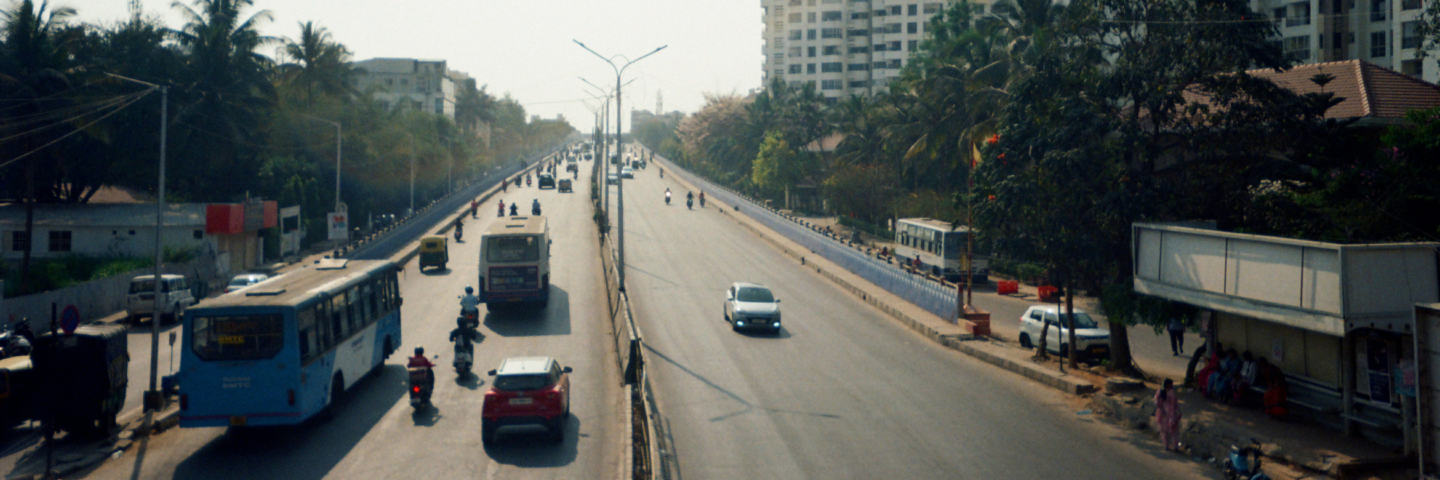
Travelling by public transport, especially BMTC buses is something that I have been doing for a long time – about 8 years now. I take one of the traditional bus routes in Bangalore (Mysore Road) which has cultural and historical significance [1] and thus embarking on this bus journey is an adventure that encloses a multitude of experiences. As I settle into the window seat, the world outside becomes a bioscope of sights and scenes.
Amidst the fellow passengers’ conversations which can range from vegetable prices to politics, there is also the conductors’ fervent call for the correct fare, “Chilree idre ne bus hatbeku” (Board the bus only if you have loose change) blows in. In my observation, it appears that this sentence has been used more frequently in recent times as the loose change that the conductor used to have has come to a decline, coinciding with the implementation of the ‘Shakti scheme’. While this problem precedes the Shakti scheme, the scale of it was minimal. Thus, when someone hands the conductor a ₹100 denomination for a ₹5 / ₹15 ticket, his anger breaks out and while writing the balance behind the ticket he uses the most common phrase “Chilree tarbeku neevu. Yallinda tarodu nanu? Collection ee aytilla” (You should carry loose change with you. Where will I get it from given there is no collection happening?). The Shakti Scheme also appears to have contributed to the increased use of buses by women; it appears to irk men who complain about how women are occupying their seats as well. The other day, while I was traveling back home, looking at the prevailing women crowd on the other side of the bus, a man behind me grumbled “Bus free aadanantara, ee mahileyaru iro baro kade oodadodarinda, namage kasta aagtide“ (After the bus travel is made free, we are facing problems as these women are travelling with no specific purpose). This was overheard by women nearby who questioned the man regarding benefits to his own family members “Yakri, nim amma- akka tangindeeru balasalva bussu?” (Why sir, aren’t women at your home benefitted by the scheme?). This back and forth went on until the conductor interfered and calmed them down. I have noticed that oftentimes, the conductor, more or less, appears to be the last resort for the problems in the bus.
Conductors themselves are also fascinating. Some are chit-chatters, some are caring, some are aspirational while others are fed up with their jobs, some stop fights and a few bring up one especially when the bus is packed with people and they are hanging alongside the door. But what I have observed is that most of them are very hard-working and good storytellers. For instance, I was having a conversation with a conductor on the prevailing city traffic as we were stuck in a traffic jam. When he realized that I was majoring in Economics, he started explaining to me a few prominent micro-economic concepts by drawing diagrams in the air. He asked me whether these diagrams that he was drawing were right or not. He told me that he had a B. Com and M.A (Economics) degree through distance learning and was preparing for KSET. He was trying for government services while working as a conductor and didn’t want to work for a private firm. It was a very engaging conversation that still brings a smile to my face.
Apart from conductors, there are also other storytellers that I encounter in my travel. Passengers who are in their 60/70s are particularly eager to narrate their life experiences. Once, a person in his late 70s told me about his experiences around the Kengeri area. He said to me that what today is referred to as ‘Kengeri Mori’ (Kengeri gutter) was the mesmerising Vrishabhavati River during the 1960s. When he was a child, he, along with family or friends used to spend time around. He recalls the area to be a semi-forest type with a lot of coconut trees and seemingly infinite peacocks. He told me that he feels both angry and sad at the same time when children these days refer to it as mori (gutter) as it was a significant part of his childhood.
While all of the stories that I am listening to while travel might seem idyllic, it is not always easy to travel. Taking a BMTC during the rainy season is especially challenging. As the rain pours down, it seems that some buses are not equipped to handle the downpour gracefully. The result? A rather uncomfortable situation where rainwater finds its way through the cracks of the bus roof, leaving passengers to experience rain even within the ‘protection’ of the bus. I recall one such incidence wherein it was pouring rain outside, and I felt safe and dry in the comfort of my window seat on the bus. Suddenly, water started dripping on head. Soon enough, it was more than just a drip – it was a deluge in the making. I had to leave my seat and continue the whole journey standing trying to avoid the relentless raindrops.
Often, I think of my bus journeys as a TV series which has its own unique genre – I feel that not everyone appreciates or likes it. On my daily bus journey, I often see children playing out on the streets, laughing and carefree. I also see people begging for food and sleeping on the footpaths, struggling to survive. These experiences have taught me the importance of appreciating the simple things in life. They have also taught me to be more compassionate towards others. More importantly, the travel has helped me understand different human experiences. As the old man taught me, maybe the physical environment might change, the policies around buses might change, the people who inhabit or use the bus might change, but what is constant is that the bus provides a unique window into the lives of people. On any given day, I do not always know what lessons I will encounter, and what experiences I will get to have, but what I can be assured of is that mobility provides more than just a way of getting from one place to another. They provide a wider view of the world and the lesson that different perspective matters. Perhaps, the most important thing about traveling in the bus for me is that regardless of what happens, the stories remain.
[Disclaimer: Views presented above are those of the author and do not necessarily reflect those of CBPS]
[1] There are anecdotal evidences of inscriptions in temples mentioning a trade route between Bangalore and Mysore during the era of Tipu Sultan.
Photo by Bhargav Panchal on Unsplash