


How do women “go missing” not just from police records but from our collective narratives?
Can the idea of “family” as we know it hold space for women’s autonomy and independence?
What happens when a town is marked a “crime hub” and young men and women begin to be marked by it too?
Can masculinities also marked by the spaces they are embedded in, soften, shift, include?
For over four decades, Gamana Women’s Collective, in partnership with Society for Informal Education and Development Studies (SIEDS), has been part of the feminist struggle for justice — not only responding to gender-based violence but also unravelling the structural forces that sustain it.
A few years ago, in collaboration with the Centre for Budget and Policy Studies (CBPS), and in partnership with several local organisations and institutions we undertook two action-research studies in Kolar and Anekal — two rapidly transforming geographies on the peripheries of Bengaluru. In Kolar, the study focused on the issue of women who were marked as “missing” from their families according to police records. It was largely presumed that these women had been trafficked into Bengaluru for sex work. In the context of a district that has rapidly transformed from a semi-urban/rural centre supplying agricultural produce to Bengaluru into an independent industrial hub. The research reveals what drove the women away from their families and what brought them back. It’s a tale not just of subordination but also of autonomy, and the invisible and institutional forces at play in a rapidly evolving landscape.
In Anekal, a town now stigmatized as a “crime town,” we used the lens of masculinity to understand the contemporary nature of crime and its impact on young men, gender relations, and changing caste/religious identities. This town, which has been at the epicentre of successive waves of industrialization, development, and urbanization since the 1970s, presents a unique case of how crime and masculinity intersect. Through conversations with a diverse community of youth, women, and men, the study offers insights into how an inclusive space could possibly nurture less destructive, more fluid notions of masculinity, challenging dominant narratives about legality, gender, and morality.
These studies are not just reports in the conventional sense. Nor are they unique. They are mirrors, maps, and memory-holders that ask us to reflect on the evolving nature of gender, autonomy and belonging in everyday life. From women marked “missing” to young men navigating criminalized masculinities, the stories emerging from Kolar and Anekal compel us to engage with uncomfortable truths about independence, crime, punishment, justice, shame, caste, identity, politics and community.
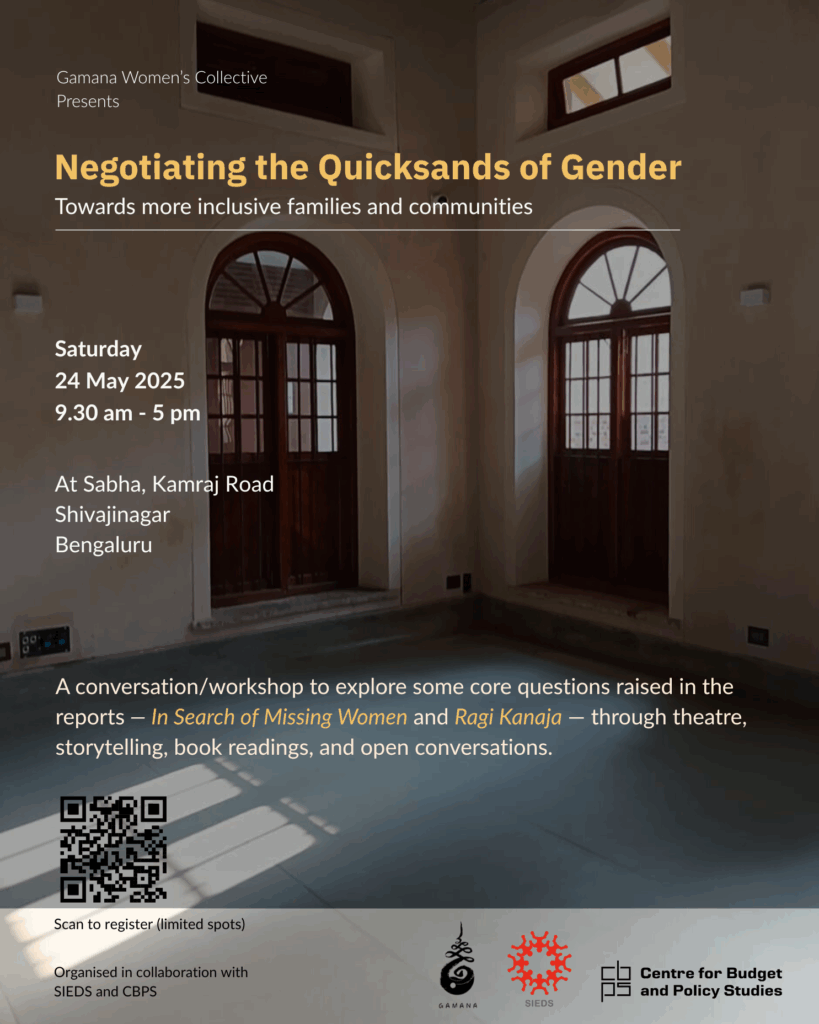
This gathering on May 24 at Sabha Bengaluru (Kamraj Road, Shivajinagar) is an invitation to enter those questions raised by the reports — creatively and collectively — through theatre, storytelling, book readings, and open conversations. Together, we will explore:
Can independent and autonomous women redefine the idea of family itself?
Can masculinity be reimagined in the context of more inclusive communities?
Can the State become more accountable to and inclusive of those marked as social and legal outcasts?
The Workshop
The day will begin with performance and storytelling by community members, followed by parallel sessions exploring lived experiences and readings from the action research studies. The afternoon will bring together feminist practitioners and thinkers in a plenary conversation, in dialogue with voices from the community.
To register for the event, click here.
To view the programme schedule, click here.
The above details are also available in Kannada here.